Toronto, Canada - Articsok Gallery opens an exhibition of the internationally renowned sculptor Blake Ward: ‘Just Beneath the Surface’. Opening: Thursday, October 9, 2014, 6-9pm at 1697 St. Clair avenue West, Toronto.
October 9, 2014 – November 9, 2014.
Blake Ward was born in Yellowknife in the North West Territories in Canada, then raised and educated in Edmonton, Alberta where he received his Bachelor of Fine Arts in 1979 from the University of Alberta. Having exhausted his repertoire of steel abstract sculptures, he found his true interest lay in classical figurative sculpture. Unable to find a teacher in Canada, Blake moved to Paris in 1985 where he studied with Cyril Heck until 1989. When the opportunity arose to be closer to the foundry of his choice, Foundry Venturi Arte in Bologna, he moved to his current studio in Monte Carlo in 1991.
Blake sculpts live models in clay, then uses the “lost wax method” before the final bronze is cast. For the two decades, the marbles have been hand carved replicas produced at Franco Cervietti in Pietrasanta, Italy. Blake adopts the European convention of limiting his bronze sculptures to twelve copies made up of four “artist’s proofs” and the “main body” of eight models. The difference between the two categories remains in name only, as there is no physical difference between the actual bronze copies. The marble sculptures are made to a maximum of six editions. Blake signs all the sculptures and many of them contain a ”key” to insure against replication.
The early works focus on classical figurative sculpture with traditional techniques used since antiquity. Finding inspiration in the work of Degas and Rodin, Blake presents modern evocations of classical themes based on movement, dance, mythology, feminism and the human spirit. Technical precision and anatomical accuracy are evident in these early sculptures. Then, Blake’s work evidenced a socio-political voice calling out the humanitarian dreams of justice, truth and equality.
Combining art with activism began when Blake was invited to teach at the University of Hanoi in 2003. While traveling throughout Viet Nam, he learned about the tragic effects of landmines in post-conflict countries. His inspiration turned to “intentional art”, where concept and purpose point directly at an issue, while simultaneously proposing aspects of the solution. In his “Fragments” collection, Blake deliberately “de-sculpted” the figures, questioning ancient ideas of beauty relative to the destructive nature of our modern times. There are 19, one-quarter life size sculptures, each named after a landmine. In association with No More Landmines and Adopt A Minefield of the United Nations, the proceeds of the sale of Fragments have aided in education and the clearing of minefields in Cambodia, Afghanistan, and Angola.
Blake’s activism expanded to another series of work, Rethink, where his love for figurative sculpture was invigorated by a new sense of what art can actually do. Rethink aims for provocation, asking viewers to question their beliefs about truth, law, equality, faith and religion. The Vietnamese Virgin Mary was created in a class in Viet Nam with the intention of reflecting a global religion.
Blake’s installation piece, The Burning Buddha, shows a female Buddha in the act of self-immolation, the ultimate act of political protest. Newer sculptures, such as This is Not Christ, have been repainted and marked with graffiti—a deliberate wake up call to the holders of authoritarian and rigid dogmas.
His latest series, The Spirits, have crossed over into the abstract and ethereal realms where he aims for provocative figures (Angels and Phantoms) that are able to expand the consciousness of our inner realities.
Holding fast to his love of the human figure, Blake remains true to the representational quality and realistic proportions of traditional sculpture while simultaneously exploring new ways to comment on the trinity of human complexity: mind, body, and spirit. Realizing that our lives flow between our inner world and how we interact with the external world, the idea of opening up an interior to the figurative pieces began to take form.
Angels and Phantoms are birthed with two intertwining structures. The external structure, with its vulnerable and textured surface, holds the figurative aspect; while an internal framework, which is flowing and bright, continues the aesthetic origins of who we really are. The outer surface is our Physical self, while the inner structure is our Individual, more organic self twisting and turning as we evolve our souls, our character and what we imagine as our spirit. Each of these works is unique and will not be reproduced.
Blake’s art has shown in Monaco, England, Germany, Italy, Singapore, Hong Kong, Delhi, The United States and Canada.
Articsok Gallery, www.articsokgallery.com
Wednesday, October 8, 2014


Monday, October 6, 2014
Degas's famous sculpture Little Dancer celebrated in exhibition at National Gallery of Art

"Thanks to the generosity of Gallery benefactor Paul Mellon, the Gallery has the largest and most important collection of Degas's original wax sculptures, including the groundbreaking Little Dancer Aged Fourteen, one of the best-loved sculptures of all time," said Earl A. Powell III, director, National Gallery of Art. "Well-known through more than 30 posthumous bronze casts displayed in museums around the world, the Gallery's wax version of Degas's famous sculpture is the only one that was formed by the artist's own hands and the only one he ever showed publicly."
The Gallery has the third largest collection of Degas works in the world, including 12 cast bronzes, one posthumously produced plaster, 19 paintings, 71 works on paper, and 52 original Degas works in wax, clay, and plaster.
Little Dancer Aged Fourteen is be presented with 13 additional works that exemplify Degas's fascination with the practice and performance of ballet, including the monumental pastel Ballet Scene (c. 1907) and monotype The Ballet Master (c. 1874) from the Gallery's collection, and oil painting The Dance Class (c. 1873) from the Corcoran Gallery of Art. These works join the smaller statuettes Study in the Nude of Little Dancer Aged Fourteen (c. 1878–1881) and Fourth Position Front, on the Left Leg (c. 1885/1890), each about two feet tall.
The exhibition also highlights the experimental, modern approach Degas took to his work. Degas did not carve sculpture but used an additive process. Little Dancer was modeled in wax over a metal armature, bulked with organic materials including wood, rope, and even old paintbrushes in the arms. It was then covered with clay and layers of pigmented wax. Degas further elevated the sculpture's realism by affixing a wig of human hair to the head and outfitting his ballerina in a cotton-and-silk tutu, a real bodice, and linen slippers.
The Ballet Master was likely the artist's first attempt at monotype, made in collaboration with his friend Viscount Ludovic Napoléon Lepic (1839-1889), who taught Degas this challenging printmaking technique, which produced only a single, lush impression of each image. Degas enhanced the print with white to create an effect of both dancer and ballet master emerging eerily from an inky darkness.
The exhibition features three other monotypes which Degas heightened extensively with pastel. Dynamic and vibrantly colored, they perfectly capture the luminous effect of the gas-lit stages. Degas frequently explored the dancers' world off-stage, depicting them at rehearsal or standing in the wings, awaiting the start of the performance. He was a keen observer and a wry but sympathetic chronicler of the daily life of the dancers he studied, even on occasion introducing a black-clad gentleman, an abonné (or subscriber), watching from an opera box or lurking behind the scenes as a potential "protector" of the young dancers.
In addition, the exhibition includes a portrait drawing of Degas by his friend, the artist Paul Mathey (1844–1929). In it Degas stands looking at a work of art in a posture loosely recalling that of his Little Dancer muse, arms behind his back, hands clasped.
Degas's Little Dancer is organized by the National Gallery of Art and curated by Alison Luchs, curator of early European sculpture.
Degas Sculptures: History and Research
Degas made sculpture throughout his life. Contemporaries record that when they visited his studio they were just as likely to find him modeling in wax and clay as they were to find him at the easel. Yet Degas's obsessive tendency to work and rework his sculptures destroyed some in the process and left others unfinished. Even the Little Dancer was subject to his whim. In 1880, though included in an exhibition program, the sculpture's case was left empty. When it was finally exhibited, the sculpture appeared two weeks late.
Many critics dismissed Little Dancer as "repulsive" and "a threat to society." They were accustomed to more traditional female subjects, such as goddesses, allegorical figures, or heroines from literature—not a contemporary, working-class girl in training for a profession with a risky reputation. (These petit rats de l'opéra, or "opera rats," were viewed by many at the time as subject to moral corruption.) Degas's unorthodox process and materials, which included human hair, silk ribbon, linen, rope, cork, cotton muslin, and silk tulle, provoked further objections. But Degas endowed his subject with humanity. Poised between girl and woman, the bony figure of the young ballerina is simultaneously vulnerable and proud. Shoulders back and her head held high, her posture is erect and dignified.
Recent discoveries by National Gallery of Art staff have contributed greatly to the understanding of the unconventional materials Degas used in making his sculptures. Through technical study by Shelley G. Sturman, head of object conservation, and Daphne S. Barbour, senior object conservator, as well as scientific analyses by Barbara H. Berrie, senior conservation scientist, Suzanne Quillen Lomax, organic chemist, and Michael Palmer, conservation scientist, it is now known that the artist formed most of his sculptures from such materials as pigmented beeswax and nondrying modeling clays. Degas usually built his own armatures from brass or galvanized-iron wires, and formed the sculptures over them, filling them with anything at hand—cork, paper, rope, and even discarded objects like the lid of a salt shaker or used paint brushes.
These research findings along with exhaustive art historical information on all Degas sculptures in the National Gallery of Art's collection were published in the landmark systematic catalog Edgar Degas Sculpture by Suzanne G. Lindsay, Shelley G. Sturman, and Daphne S. Barbour, published by the Gallery in 2010 and distributed by Princeton University Press.
More Information: http://artdaily.com/news/73370/Degas-s-famous-sculpture-Little-Dancer-celebrated-in-exhibition-at-National-Gallery-of-Art-#.VDKpx1fSu6M[/url]
Copyright © artdaily.org
Wednesday, February 27, 2013
First major exhibition on Pre-Raphaelite Art and Design in United States on view at National Gallery of Art
WASHINGTON, DC.- Combining rebellion, scientific precision, beauty, and imagination, the Pre-Raphaelites created art that shocked 19th-century Britain. On view from February 17 through May 19, 2013, at the National Gallery of Art, Washington—the sole U.S. venue—Pre-Raphaelites: Victorian Art and Design, 1848–1900 is the first major survey of the art of the Pre-Raphaelites to be shown in the United States.
 John Everett Millais, Ophelia, 1851-1852. Oil on canvas, 76.2 x 111.8 cm (30 x 44 in.) Tate. Presented by Sir Henry Tate 1894.
The exhibition features some 130 paintings, sculptures, photography, works on paper, and decorative art objects that reflect the ideals of Britain's first modern art movement. "The Pre-Raphaelites rejected the rigid rules for painting that prevailed at the dawn of the Victorian era to launch Britain's first avant-garde movement," said Earl A. Powell III, director, National Gallery of Art. "We are thrilled to present this rare exhibition to our audiences and grateful to lenders, both public and private, as well as our generous sponsors. Notably, we have received a generous amount of loans from Tate Britain and the Birmingham Museums Trust in the United Kingdom." The Pre-Raphaelites The Pre-Raphaelite Brotherhood (PRB) was founded in London in September 1848 at a turbulent time of political and social change. Many Victorians felt that beauty and spirituality had been lost amid industrialization. The leading members of the PRB were the painters John Everett Millais, Dante Gabriel Rossetti and William Holman Hunt, young students at the Royal Academy of Arts. They all believed that art had become decadent, and rejected their teachers' belief that the Italian artist Raphael (1483–1520) represented the pinnacle of aesthetic achievement. Instead, they looked to medieval and early Renaissance art for inspiration. Whether painting subjects from Shakespeare or the Bible, landscapes of the Alps, or the view from a back window, the Pre-Raphaelites brought a new sincerity and intensity to British art. The exhibition is organized into eight themes: Beginnings: The Pre-Raphaelites were both historical and modern in their approach. While they borrowed from the art of previous centuries, they also listened to critic John Ruskin's call to observe nature and represent its forms faithfully. In balancing the past with the world they saw before them, the Pre-Raphaelites crafted a modern aesthetic. Some of their important early works—such as Hunt's Valentine rescuing Sylvia from Proteus—Two Gentlemen of Verona (Act V, Scene iv) (1850–1851) and Millais's Christ in the House of His Parents (The Carpenter's Shop) (1849–1850)—reveal the emergence of this new style. History: Dramatic narratives from the Bible, classical mythology, literature, or world history had dominated European art since the establishment of art academies in the 17th century. The Pre-Raphaelites rejected these grand narratives to focus on intimate human relationships. Millais set the standard, adopting a precise style and drawing from British history and popular operas while emphasizing accuracy of dress and settings. The results—seen in A Huguenot, on Saint Bartholomew's Day, Refusing to Shield Himself from Danger by Wearing the Roman Catholic Badge (1851–1852) and The Order of Release, 1746 (1852–1853)—defied convention, provoked critics, and entranced audiences. Literature and Medievalism: Pre-Raphaelitism was also a literary movement. The artists took subjects from Shakespeare, Dante Alighieri, and other medieval tales, as in Millais's beloved painting Ophelia (1851–1852). Several wrote poetry, including Rossetti, who with Elizabeth Siddall (who served as Rossetti's muse, model, lover, and eventually wife) created intensely colored, intricate watercolors based on medieval manuscript illumination and themes of chivalric love, seen in his The Wedding of Saint George and the Princess Sabra (1857). Soon Rossetti's younger followers Edward Burne-Jones and William Morris incorporated medieval subjects in their designs for furniture, stained glass, and other decorative arts. Salvation: The Pre-Raphaelites addressed morality and salvation in subjects drawn from both religion and modern life. Religious and moral thinking permeated everyday life, whether in regard to ideas of class and society, relationships between the sexes, or ideals of domesticity, which they examined in works such as Hunt's The Awakening Conscience (1853–1854) and Ford Madox Brown's Work (1863). Rejecting traditional religious imagery, the Pre-Raphaelites painted biblical scenes with unprecedented realism. Hunt was so committed to truthful representation that he traveled to the Holy Land, where he painted the actual settings of biblical events, seen in The Shadow of Death (1870–1873). Nature: The Pre-Raphaelite artists developed a fresh and precise method of transcribing the natural world in oil paint, based on direct, up-close observation and working out of doors. At a time of debates about evolution and the history of the earth (Charles Darwin's On the Origin of Species was published in 1859), Pre-Raphaelite landscape paintings reflected the artists' interest in the natural sciences, geology, botany, meteorology, and even astronomy. Groundbreaking works such as Brown's An English Autumn Afternoon, Hampstead—Scenery in 1853 (1852–1855) and "The Pretty Baa-Lambs" (1851–1859) newly emphasized rendering precise detail and natural light. Beauty: Around 1860, the Pre-Raphaelites turned away from realist depictions of history, literature, modern society, religious themes, and nature scenes to explore the purely aesthetic possibilities of painting. The female face and body became the most important subjects, in erotically charged works that had little precedent. Beauty came to be valued more highly than truth, as Pre-Raphaelitism slowly shifted into the Aesthetic Movement. Rossetti was the dominant force as his work became more sensuous in style and subject, seen in Bocca Baciata (1859), Beata Beatrix (c. 1864–1870), and Lady Lilith (1866–1868, altered 1872–1873). Paradise–Decorative Arts: Inspired by the Pre-Raphaelites and the medieval past, Morris established a decorative arts firm in 1861 with partners Rossetti, Brown, and Burne-Jones. In 1875 Morris reorganized the company under his sole direction as Morris & Co. aiming to erase the distinction between the fine and applied arts. The firm produced tiles, furniture, embroidery, stained glass, printed and woven textiles, carpets, and tapestries for both ecclesiastical and domestic interiors. Several examples are on view, from stained glass, furniture painted with medievalized themes, and a three-fold screen with embroidered panels of heroic women on loan from Castle Howard, to popular tile, textile, and wallpaper designs, including the iconic Strawberry Thief (1883). In the last decade of his life, Morris founded the Kelmscott Press for the production of high-quality, hand-printed books. This room also includes two stunning tapestries designed by Burne-Jones and Morris from the series based on the Arthurian story of the Holy Grail. Mythologies: Late Pre-Raphaelite paintings reflect a fascination with the world of myth and legend. Rossetti and Burne-Jones embraced imagination and symbolism, focusing on the human figure frozen in a drama. Both found inspiration in Renaissance art after Raphael, concentrating on sensuous Venetian color and the sculptural forms of Michelangelo, seen in Rossetti's La Pia (1868–1881) and Burne-Jones' Perseus series (1885–1888). Hunt adhered more closely to the initial realist Pre-Raphaelite style, which he brought to his late masterpiece, The Lady of Shalott (c.1888–1905).
http://www.artdaily.com/index.asp?int_sec=2&int_new=60890#.US4a9zdjOKI

The exhibition features some 130 paintings, sculptures, photography, works on paper, and decorative art objects that reflect the ideals of Britain's first modern art movement. "The Pre-Raphaelites rejected the rigid rules for painting that prevailed at the dawn of the Victorian era to launch Britain's first avant-garde movement," said Earl A. Powell III, director, National Gallery of Art. "We are thrilled to present this rare exhibition to our audiences and grateful to lenders, both public and private, as well as our generous sponsors. Notably, we have received a generous amount of loans from Tate Britain and the Birmingham Museums Trust in the United Kingdom." The Pre-Raphaelites The Pre-Raphaelite Brotherhood (PRB) was founded in London in September 1848 at a turbulent time of political and social change. Many Victorians felt that beauty and spirituality had been lost amid industrialization. The leading members of the PRB were the painters John Everett Millais, Dante Gabriel Rossetti and William Holman Hunt, young students at the Royal Academy of Arts. They all believed that art had become decadent, and rejected their teachers' belief that the Italian artist Raphael (1483–1520) represented the pinnacle of aesthetic achievement. Instead, they looked to medieval and early Renaissance art for inspiration. Whether painting subjects from Shakespeare or the Bible, landscapes of the Alps, or the view from a back window, the Pre-Raphaelites brought a new sincerity and intensity to British art. The exhibition is organized into eight themes: Beginnings: The Pre-Raphaelites were both historical and modern in their approach. While they borrowed from the art of previous centuries, they also listened to critic John Ruskin's call to observe nature and represent its forms faithfully. In balancing the past with the world they saw before them, the Pre-Raphaelites crafted a modern aesthetic. Some of their important early works—such as Hunt's Valentine rescuing Sylvia from Proteus—Two Gentlemen of Verona (Act V, Scene iv) (1850–1851) and Millais's Christ in the House of His Parents (The Carpenter's Shop) (1849–1850)—reveal the emergence of this new style. History: Dramatic narratives from the Bible, classical mythology, literature, or world history had dominated European art since the establishment of art academies in the 17th century. The Pre-Raphaelites rejected these grand narratives to focus on intimate human relationships. Millais set the standard, adopting a precise style and drawing from British history and popular operas while emphasizing accuracy of dress and settings. The results—seen in A Huguenot, on Saint Bartholomew's Day, Refusing to Shield Himself from Danger by Wearing the Roman Catholic Badge (1851–1852) and The Order of Release, 1746 (1852–1853)—defied convention, provoked critics, and entranced audiences. Literature and Medievalism: Pre-Raphaelitism was also a literary movement. The artists took subjects from Shakespeare, Dante Alighieri, and other medieval tales, as in Millais's beloved painting Ophelia (1851–1852). Several wrote poetry, including Rossetti, who with Elizabeth Siddall (who served as Rossetti's muse, model, lover, and eventually wife) created intensely colored, intricate watercolors based on medieval manuscript illumination and themes of chivalric love, seen in his The Wedding of Saint George and the Princess Sabra (1857). Soon Rossetti's younger followers Edward Burne-Jones and William Morris incorporated medieval subjects in their designs for furniture, stained glass, and other decorative arts. Salvation: The Pre-Raphaelites addressed morality and salvation in subjects drawn from both religion and modern life. Religious and moral thinking permeated everyday life, whether in regard to ideas of class and society, relationships between the sexes, or ideals of domesticity, which they examined in works such as Hunt's The Awakening Conscience (1853–1854) and Ford Madox Brown's Work (1863). Rejecting traditional religious imagery, the Pre-Raphaelites painted biblical scenes with unprecedented realism. Hunt was so committed to truthful representation that he traveled to the Holy Land, where he painted the actual settings of biblical events, seen in The Shadow of Death (1870–1873). Nature: The Pre-Raphaelite artists developed a fresh and precise method of transcribing the natural world in oil paint, based on direct, up-close observation and working out of doors. At a time of debates about evolution and the history of the earth (Charles Darwin's On the Origin of Species was published in 1859), Pre-Raphaelite landscape paintings reflected the artists' interest in the natural sciences, geology, botany, meteorology, and even astronomy. Groundbreaking works such as Brown's An English Autumn Afternoon, Hampstead—Scenery in 1853 (1852–1855) and "The Pretty Baa-Lambs" (1851–1859) newly emphasized rendering precise detail and natural light. Beauty: Around 1860, the Pre-Raphaelites turned away from realist depictions of history, literature, modern society, religious themes, and nature scenes to explore the purely aesthetic possibilities of painting. The female face and body became the most important subjects, in erotically charged works that had little precedent. Beauty came to be valued more highly than truth, as Pre-Raphaelitism slowly shifted into the Aesthetic Movement. Rossetti was the dominant force as his work became more sensuous in style and subject, seen in Bocca Baciata (1859), Beata Beatrix (c. 1864–1870), and Lady Lilith (1866–1868, altered 1872–1873). Paradise–Decorative Arts: Inspired by the Pre-Raphaelites and the medieval past, Morris established a decorative arts firm in 1861 with partners Rossetti, Brown, and Burne-Jones. In 1875 Morris reorganized the company under his sole direction as Morris & Co. aiming to erase the distinction between the fine and applied arts. The firm produced tiles, furniture, embroidery, stained glass, printed and woven textiles, carpets, and tapestries for both ecclesiastical and domestic interiors. Several examples are on view, from stained glass, furniture painted with medievalized themes, and a three-fold screen with embroidered panels of heroic women on loan from Castle Howard, to popular tile, textile, and wallpaper designs, including the iconic Strawberry Thief (1883). In the last decade of his life, Morris founded the Kelmscott Press for the production of high-quality, hand-printed books. This room also includes two stunning tapestries designed by Burne-Jones and Morris from the series based on the Arthurian story of the Holy Grail. Mythologies: Late Pre-Raphaelite paintings reflect a fascination with the world of myth and legend. Rossetti and Burne-Jones embraced imagination and symbolism, focusing on the human figure frozen in a drama. Both found inspiration in Renaissance art after Raphael, concentrating on sensuous Venetian color and the sculptural forms of Michelangelo, seen in Rossetti's La Pia (1868–1881) and Burne-Jones' Perseus series (1885–1888). Hunt adhered more closely to the initial realist Pre-Raphaelite style, which he brought to his late masterpiece, The Lady of Shalott (c.1888–1905).
http://www.artdaily.com/index.asp?int_sec=2&int_new=60890#.US4a9zdjOKI
Friday, February 1, 2013
Frist Center hosts Rembrandt and the Dutch Golden Age: Highlights from the Detroit Institute of Arts

http://www.artdaily.com/index.asp?int_sec=2&int_new=60451#.UQvOX2dtX3U
Thursday, January 10, 2013
Rijksmuseum in Amsterdam: One of the most important museums reopening in 2013

http://www.artdaily.com/index.asp?int_sec=2&int_new=59767#.UO7ooXdtVVU[/url]
Tuesday, January 8, 2013
Christie's to offer one of the most important collections of Albrecht Dürer's prints ever offered at auction

Albrecht Dürer, Melencolia I (B. 74; M., Holl. 75; S.M.S. 71). Engraving, 1514. S. 13 3/8 x 10 5/8 in. Estimate $400,000 - 600,000. Photo: Christie's Images Ltd 2013.
Albrecht Dürer,
Melencolia I (B. 74; M., Holl. 75; S.M.S. 71). Engraving, 1514. S. 13
3/8 x 10 5/8 in. Estimate $400,000 - 600,000. Photo: Christie's Images
Ltd 2013.
More Information: http://www.artdaily.com/[/url]
Copyright © artdaily.org
More Information: http://www.artdaily.com/[/url]
Copyright © artdaily.org
NEW YORK, NY.- Christie’s presents the sale of Albrecht Dürer Masterpieces from a Private Collection as part of Old Masters Week. The sale, which will take place 29 January, features 62 exceptional impressions by Albrecht Dürer, and constitutes one of the most important collections of his prints ever offered at auction. Encompassing a wide range of subject matter, both religious and secular, and mediums - engravings, woodcuts and etchings - the collection was amassed with the objective of adding only the very best examples. The sale is expected to realize in excess of $4.6 million. Melencolia I (estimate: $400,000-600,000), engraved in 1514, is one the most enigmatic images in the history of western art. The subject is probably an allegory of melancholy, but the details of its iconography have intrigued and inspired countless art historians and scholars. It contains symbols seen elsewhere in Dürer’s oeuvre, such as the sphere as a symbol of chance or fate from Nemesis (lot 26), the scales from Sol Iustitiae (lot 1), and the skull and the hour-glass, which appear as memento mori on the other two of the so-called ‘Master Prints’: Knight, Death and the Devil and Saint Jerome in his Study (lots 44 and 45). In the 16th century, the melancholic temperament was associated with genius and the pursuit of knowledge. If Saint Jerome and Melencolia I are indeed companion pieces, and Saint Jerome represents the knowledge of texts, then Melencolia I stands for a different, new kind of knowledge - that of empirical, applied science. The ruler, the scale and the pair of compasses are all measuring devices, instruments for the examination of nature. For Dürer, the observation and comprehension of the natural world was the basis of art. Considering that the artists of the Renaissance, with Leonardo and Dürer as prime examples, saw themselves as artists as well as scientists, then Melencolia I might be described as a secret self-portrait. Knight, Death and the Devil (estimate: $500,000-700,000), 1513, depicts a knight in armor on his magnificent charger making his way through a rocky gorge. Two figures stand by the wayside, as if emerging from the rocks; King Death with snakes winding through his crown, astride an old mare, holding an hourglass; and a monstrous devil standing on his hoofs, holding a pike. Countless attempts have been made to identify the central figure, which Dürer simply referred to as der Reuther (‘the rider’). Suggestions have included emperor, pope, heretic, Germanic hero and local patrician. None of the potential candidates, either historical or mythological, have been substantiated. The knight as robber baron - a genuine threat in the days of Dürer - is lacking visual evidence. Whatever his true identity, Dürer’s rider is clearly cast in the heroic mold, a model of courage and moral strength, the Christian Knight, who does not fear Death or the Devil. Dated 1514, Saint Jerome in his Study (estimate: $300,000-500,000) was engraved one year after Knight, Death and the Devil (lot 44), and like the earlier print it is full of reminders of death: the human skull on the window ledge, the crucifix on the desk, the candle and the hour glass, while the fly whisk can be read as a reference to the devil. Together with Melencolia I (lot 42) these three engravings have long been known as the ‘Master Prints’. The term is appropriate as with these prints Dürer undoubtedly reached the height of his capacities as an engraver. Aside from their technical excellence, the prints are also connected by their near-identical format and their concentration on a single figure in a highly complex, richly symbolic environment. If, as has been suggested, they represent the three different modes of virtuous living, Saint Jerome depicts the lonely, quiet life of the man of letters. The Four Horsemen of the Apocalypse (estimate: $120,000-180,000), is arguably the most dramatic and dynamic of all of Dürer’s compositions. Standing before this work, the viewer witnesses the four horsemen as they burst out of heaven, one after the other, and thunder over the earth. The mouth of hell opens up below, devouring a ‘lord of the earth’ - perhaps a bishop or king. Everything conveys a sense of violence and rupture. Erwin Panofsky observed that the three horses in the air are shown at different intervals of their galloping movement, thereby creating the impression of time and continuity, not unlike Eadweard Muybridge’s photographic recordings of bodies in motion almost five hundred years later. The Rhinoceros (estimate: $100,000-150,000) was cut in 1515, the year that the first rhinoceros was seen in Europe since Antiquity. Having never seen a rhinoceros, Dürer learned of it from a sketch and description sent by Valentin Ferdinand, a Moravian printer who had settled in Lisbon, to a friend in Nuremberg. Dürer’s depiction, which might pass for a terrible war machine, had tremendous impact. The woodblock was printed in no fewer than eight editions, seven of which were posthumous. Around 1620 it was printed in Amsterdam together with a tone block, producing a chiaroscuro woodcut like the portrait of Ulrich Varnbüler (lot 61). The Rhinoceros served as the model for illustrations of the species as late as the end of the eighteenth century. Although presumably printed in fairly large numbers very few survive to this day, and impressions from the first edition are exceptionally rare.
http://www.artdaily.com/index.asp?int_sec=2&int_new=60004#.UO7_SndtVVU[/url]
NEW YORK, NY.-
Christie’s presents the sale of Albrecht Dürer Masterpieces from a
Private Collection as part of Old Masters Week. The sale, which will
take place 29 January, features 62 exceptional impressions by Albrecht
Dürer, and constitutes one of the most important collections of his
prints ever offered at auction. Encompassing a wide range of subject
matter, both religious and secular, and mediums - engravings, woodcuts
and etchings - the collection was amassed with the objective of adding
only the very best examples. The sale is expected to realize in excess
of $4.6 million.
Melencolia I (estimate: $400,000-600,000), engraved in 1514, is one the
most enigmatic images in the history of western art. The subject is
probably an allegory of melancholy, but the details of its iconography
have intrigued and inspired countless art historians and scholars. It
contains symbols seen elsewhere in Dürer’s oeuvre, such as the sphere as
a symbol of chance or fate from Nemesis (lot 26), the scales from Sol
Iustitiae (lot 1), and the skull and the hour-glass, which appear as
memento mori on the other two of the so-called ‘Master Prints’: Knight,
Death and the Devil and Saint Jerome in his Study (lots 44 and 45).
In the 16th century, the melancholic temperament was associated with
genius and the pursuit of knowledge. If Saint Jerome and Melencolia I
are indeed companion pieces, and Saint Jerome represents the knowledge
of texts, then Melencolia I stands for a different, new kind of
knowledge - that of empirical, applied science. The ruler, the scale and
the pair of compasses are all measuring devices, instruments for the
examination of nature. For Dürer, the observation and comprehension of
the natural world was the basis of art. Considering that the artists of
the Renaissance, with Leonardo and Dürer as prime examples, saw
themselves as artists as well as scientists, then Melencolia I might be
described as a secret self-portrait.
Knight, Death and the Devil (estimate: $500,000-700,000), 1513, depicts a
knight in armor on his magnificent charger making his way through a
rocky gorge. Two figures stand by the wayside, as if emerging from the
rocks; King Death with snakes winding through his crown, astride an old
mare, holding an hourglass; and a monstrous devil standing on his hoofs,
holding a pike. Countless attempts have been made to identify the
central figure, which Dürer simply referred to as der Reuther (‘the
rider’). Suggestions have included emperor, pope, heretic, Germanic hero
and local patrician. None of the potential candidates, either
historical or mythological, have been substantiated. The knight as
robber baron - a genuine threat in the days of Dürer - is lacking visual
evidence. Whatever his true identity, Dürer’s rider is clearly cast in
the heroic mold, a model of courage and moral strength, the Christian
Knight, who does not fear Death or the Devil.
Dated 1514, Saint Jerome in his Study (estimate: $300,000-500,000) was
engraved one year after Knight, Death and the Devil (lot 44), and like
the earlier print it is full of reminders of death: the human skull on
the window ledge, the crucifix on the desk, the candle and the hour
glass, while the fly whisk can be read as a reference to the devil.
Together with Melencolia I (lot 42) these three engravings have long
been known as the ‘Master Prints’. The term is appropriate as with these
prints Dürer undoubtedly reached the height of his capacities as an
engraver. Aside from their technical excellence, the prints are also
connected by their near-identical format and their concentration on a
single figure in a highly complex, richly symbolic environment. If, as
has been suggested, they represent the three different modes of virtuous
living, Saint Jerome depicts the lonely, quiet life of the man of
letters.
The Four Horsemen of the Apocalypse (estimate: $120,000-180,000), is
arguably the most dramatic and dynamic of all of Dürer’s compositions.
Standing before this work, the viewer witnesses the four horsemen as
they burst out of heaven, one after the other, and thunder over the
earth. The mouth of hell opens up below, devouring a ‘lord of the earth’
- perhaps a bishop or king. Everything conveys a sense of violence and
rupture. Erwin Panofsky observed that the three horses in the air are
shown at different intervals of their galloping movement, thereby
creating the impression of time and continuity, not unlike Eadweard
Muybridge’s photographic recordings of bodies in motion almost five
hundred years later.
The Rhinoceros (estimate: $100,000-150,000) was cut in 1515, the year
that the first rhinoceros was seen in Europe since Antiquity. Having
never seen a rhinoceros, Dürer learned of it from a sketch and
description sent by Valentin Ferdinand, a Moravian printer who had
settled in Lisbon, to a friend in Nuremberg. Dürer’s depiction, which
might pass for a terrible war machine, had tremendous impact. The
woodblock was printed in no fewer than eight editions, seven of which
were posthumous. Around 1620 it was printed in Amsterdam together with a
tone block, producing a chiaroscuro woodcut like the portrait of Ulrich
Varnbüler (lot 61). The Rhinoceros served as the model for
illustrations of the species as late as the end of the eighteenth
century. Although presumably printed in fairly large numbers very few
survive to this day, and impressions from the first edition are
exceptionally rare.
More Information: http://www.artdaily.com/index.asp?int_sec=2&int_new=60004#.UO7_SndtVVU[/url]
Copyright © artdaily.org
More Information: http://www.artdaily.com/index.asp?int_sec=2&int_new=60004#.UO7_SndtVVU[/url]
Copyright © artdaily.org
Wednesday, December 12, 2012
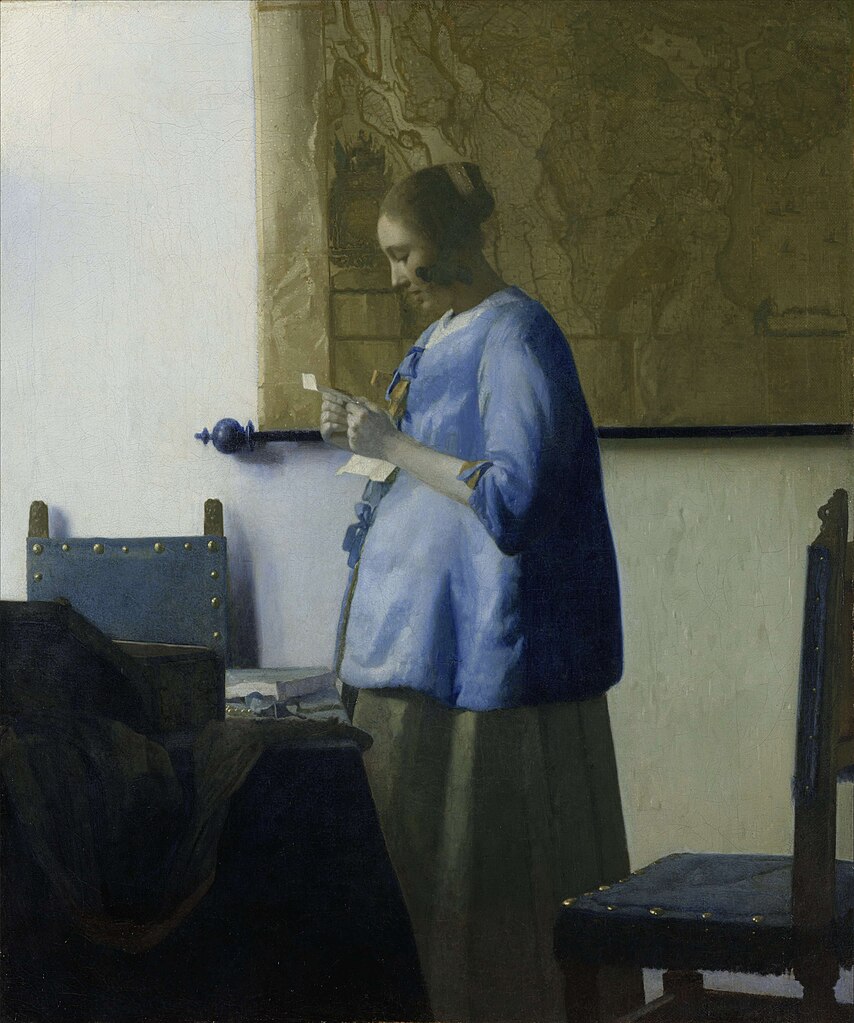
Vermeer's "Woman in Blue Reading a Letter" travels to Sao Paulo
http://www.artdaily.com/index.asp?int_sec=2&int_new=59493#.UMjtrmfNpT4[/url]
Tuesday, January 25, 2011
Germany's Prussian Cultural Heritage Foundation Refuses to Return Nefertiti Bust to Egypt

Egypt's Supreme Council of Antiquities (SCA) sent the request to the Prussian Cultural Heritage Foundation, which runs the Neues Museum in the German capital where the bust is kept.
"The foundation's position on the return of Nefertiti remains unchanged," foundation president Professor Hermann Parzinger said in a statement. "She is and remains the ambassador of Egypt in Berlin."
Egypt's antiquities chief, Zahi Hawass, appealed to the foundation seeking the return of the bust, famed for its almond-shaped eyes and swan-like neck. However, the foundation said it did not consider the letter an official state request as it had not been signed by Egyptian Prime Minister Ahmed Nazif.
German archaeologist Ludwig Borchardt discovered the bust about 275 km south of Cairo in 1912, and it was taken to Germany the following year.
Hawass, who sent a similar letter in 2009, has said in the past that documents presented by the Neues Museum confirmed Borchardt tried to pass the bust off as a less significant find to secure it for Berlin. The museum has said it was acquired lawfully and Egypt had no legal claim to it.

The SCA, which Hawass heads, said in an email that its request had been approved by both Prime Minister Nazif and the Egyptian ministry of culture.
"This request is a natural consequence of Egypt's long-standing policy of seeking the restitution of all archaeological and historical artefacts that have been taken illicitly out of the country," it said.
Hawass has campaigned to repatriate several pharaonic treasures in recent years, including the Rosetta Stone now in the British Museum.
(Reporting by Eric Kelsey in Berlin and Patrick Werr in Cairo; writing by Brian Rohan; editing by David Stamp)
http://www.artdaily.com/index.asp?int_sec=2&int_new=44425
Tuesday, January 4, 2011
MORGAN HERRIN

"Untitled Knight is the product of the combination of two subjects: 15th century plate armor, and geological cave structure. Studied separately, these two subjects are completely unrelated. The man-made geometric precision of plate armor is formally opposite the flowing, organic nature of stalactites and stalagmites. Seen together, these two parts present a striking contrast in form and create a theme of time and the effects of nature. The pose of the figure and the general composition are references to the classical sculpture “The Dying Gaul” of ancient Roman antiquity. Rendered entirely in laminated construction-grade 2 x 4s, the material itself irreverently contradicts this classical allusion, and at the same time draws attention to our own culture’s reliance on the fast, cheap, and impermanent."

1992-1993 Private Sculpture Lessons with Martin Delabono, Dallas TX
1997 Life Drawing Lessons at Southern Methodist University, Dallas TX
1997 - 1998 Private Life Drawing Lessons with Ellen Soderquist, Dallas TX
1998 - 2002 BFA from Virginia Commonwealth University, Richmond VA
2002 - 2005 MFA from The Ohio State University Sculpture program, Columbus OH

Mulherin Pollard Projects, 317 10th Ave, New York, NY
Lost World, ADA gallery, Richmond, VA
Scope New York, ADA gallery
Snap, Morlan Gallery, Lexington, KY
Diamonds Cut Diamonds, Rare, New York, NY
Columbus Biennale, Columbus OH
Exchange Rate, Richmond VA
FEAR, Polka Dot Gallery, Richmond,VA
and co-owner & director of MULHERIN POLLARD PROJECT
Wednesday, December 29, 2010
Ned Martin - Time Passages

Jan 5-27, reception Sat 8 Jan: |
Time Passages. STUDIO VOGUE Gallery is pleased to welcome Ned Martin as one of several artists featured in Time Passages, our winter exhibition of gallery artists. Martin transports the viewer to a familiar place through a universal language and gives pause, even for a brief moment, to celebrate the unique quality of his subject. Martin will be joined by Jackie Hall, J. A. Fligel, Donna Koster, Victor Oriecuia, and Vivien Schmidt among others. This eclectic selection is sure to warm up a winter's day with works in oil and acrylic, bronze and marble sculpture, and fine art photography.
Ned Martin is a Realism Oil Painter who lives in New York, New York. He spent his early life and his years as an art major at Towson State University in Maryland exploring various painting media including acrylics, watercolor, pastels, and gouache. Several years ago, he began painting in oils and furthered his formal art training at The Schuler School of Fine Art in Baltimore where he learned the traditional oil painting techniques and principles of Jacques Maroger and the Old Masters.
Ned has embraced the Schuler School experience and continues to meticulously prepare his own wood panels and grind his own paint. While his paintings appear realistic, upon close scrutiny the viewer is delighted with broken impressionistic layers of paint that imply realism. Ned invests considerably in scrubbing, scratching, and scrapping layers of textured paint until a realistic form reveals itself.
Ned Martin is a Realism Oil Painter who lives in New York, New York. He spent his early life and his years as an art major at Towson State University in Maryland exploring various painting media including acrylics, watercolor, pastels, and gouache. Several years ago, he began painting in oils and furthered his formal art training at The Schuler School of Fine Art in Baltimore where he learned the traditional oil painting techniques and principles of Jacques Maroger and the Old Masters.
Ned has embraced the Schuler School experience and continues to meticulously prepare his own wood panels and grind his own paint. While his paintings appear realistic, upon close scrutiny the viewer is delighted with broken impressionistic layers of paint that imply realism. Ned invests considerably in scrubbing, scratching, and scrapping layers of textured paint until a realistic form reveals itself.
STUDIO VOGUE Gallery – representing mid-career and emerging artists from Canada and around the world.
274 Avenue Road, Toronto ON M4V 2G7 (just N of Dupont)
Wed-Sat 12-6. Mon & Tues by appointment
T: 416 459 9809
info@studiovoguegallery.com
www.studiovoguegallery.com
Wed-Sat 12-6. Mon & Tues by appointment
T: 416 459 9809
info@studiovoguegallery.com
www.studiovoguegallery.com
Thursday, December 23, 2010
A Kingly Velázquez Is Discovered at the Met, Capping Off a Busy Year for the Old Masters

Despite possessing a 1624 receipt for the painting that was signed by Velázquez, the Met had reconsidered the portrait's authorship in the 1970s as part of a general auditing of its European painting collection that humbled attributions on 15 percent of its holdings, with the Philip canvas raising doubts in part because of over-varnishing inflicted by its previous owner, legendary dealer Lord Duveen. But a year-long restoration process of the work — which has not weathered the years well, losing an eye at one point, possibly to a vandal — has persuaded connoisseurs that the doubts had been misplaced. "One of the greatest painters of Western tradition — and a royal portrait to boot — is vindicated," Met European paintings chairman Keith Christiansen told the Times. Velázquez scholar Jonathan Brown has likewise welcomed the news. "Although it has suffered losses, what remains is by Velázquez," he said.
The reattribution comes improbably hard on the heels of another Velázquez discovery in the Met's collection, a circa 1630 "Portrait of a Man" that was determined to be by the artist's hand, and not his studio, in September of 2009. But the New York institution is not alone in finding treasures under its nose, and the Old Masters have been popping up everywhere this year. A third Velázquez was discovered by a specialist at the Yale University Art Gallery this summer — making for a remarkable spate of discoveries given that the painter is known to have made only about 110 works during his lifetime.
Then an enormous peasant scene by Pieter Bruegel the Elder was recognized by the Prado in Madrid, a Rembrandt was noticed hanging in the waiting room of the Rotterdam's Boijmans van Beuningen Museum, a giant once-waterlogged crucifix painting was attributed to Giotto in Florence, a potential Michelangelo pietà painting was spotted in an upstate New York home, and the Vatican even said it had uncovered a previously unknown Caravaggio just in time for the 400th anniversary of his death... but had to take back the claim when it was widely debunked.
By ARTINFO Published: December 21, 2010
Image is courtesy The Metropolitan Museum of Art
Wednesday, July 21, 2010
The Spectacular Art of Jean-Léon Gérôme
By STAN PARCHIN
The J. Paul Getty Museum is the first of three venues to present The Spectacular Art of Jean-Léon Gérôme (June 15-September 12, 2010). This much-anticipated special exhibition, the first of its kind in nearly 40 years, features 99 works by the French artist (1824-1904) and important contemporaries. In light of recent scholarship, the show reconsiders the life and oeuvre of the academic painter and sculptor whose brilliant career was eclipsed by the development of Impressionism, Post-Impressionism and the Modernist avant-garde. In Los Angeles, California, the installation is organized thematically and chronologically by Mary Morton, Curator and Head of the Department of French Paintings at the National Gallery of Art and Scott Allen, the Getty's Assistant Curator of Paintings.
 Jean-Léon Gérôme (French, 1824-1904). The Snake Charmer (ca. 1870). Oil on canvas. 83.4 x 122.1 cm. Sterling and Francine Clark Art Institute.
Gérôme and Painting
During the early 1840s, Jean-Léon Gérôme excelled at the atelier (studio) of noted Parisian painter Paul Delaroche (1797-1856). He continued his education with his mentor in Italy. After his return to France, Gérôme attended the prestigious École des Beaux-Arts. He competed unsuccessfully for the Prix de Rome in 1846, having been disqualified in the final round because of inadequate figure-drawing skills. This disappointment profoundly influenced the artist's perpetual preoccupation with painting the perfect nude.
 Jean-Baptiste Carpeaux (French, 1827-1875). Portrait of Jean-Léon Gérôme (1872-73). Marble. H. 61 cm. J. Paul Getty Museum.
Despite the setback, the indefatigable Gérôme's The Cockfight (1847), a genre scene of adolescent sexuality set in a classical landscape, was well-received at that year's Salon. The recognition bolstered the artist's ambitions as a history painter throughout most of the next decade. He was foiled once again when the critics' disliked his monumental allegorical The Age of Augustus (1855), an official commission for French Emperor Napoleon III (r. 1851-70).
The disillusioned Gérôme then turned his attentions to small-scale historical and Orientalist compositions. The Death of Caesar (1867) was acknowledged for the artist's meticulous rendering of the immense Roman Senate's archaeological details as well as its portrayal of the dramatic events that unfolded following the ruler's cold and calculated assassination. The inventive imagery of Gérôme's subsequent The Snake Charmer (ca. 1870) was due, in part, to his 1853 trip to Constantinople (modern-day Istanbul, Turkey). There he derived inspiration from everyday life in the East to paint exotic scenes with the realistic clarity of photography, a new medium he greatly admired.
 Jean-Léon Gérôme (French, 1824-1904). The Death of Caesar (1867). Oil on canvas. 85.5 x 145.5 cm. Walters Art Museum.
The Lure of Sculpture
Always interested in antique art, Gérôme devoted much of his later career to sculpture, frequently cross-referencing his paintings and statues. The artist premiered his first bronze sculpture, a gladiator trampling upon his victim, at the Universal Exposition of 1878.
The current exhibition displays 10 of Gérôme's works in bronze, marble, ivory and mixed media. It also fittingly includes the painter's famous oil on canvas Pygmalion and Galatea (1890), in which he retells the ancient Roman myth about a sculptor who fell in love with his own creation brought to life by a goddess.
 Jean-Léon Gérôme (1824-1904). Pygmalion and Galatea (ca. 1890). Oil on canvas. 88.9 x 68.6 cm. The Metropolitan Museum of Art/Art Resource, NY.
After the J. Paul Getty Museum, "The Spectacular Art of Jean-Léon Gérôme" travels to the Musée d'Orsay, Paris (October 18, 2010-January 23, 2011) and the Thyssen-Bornemisza Museum, Madrid (March 22- June 12, 2011).
Source
Morton, Mary and Scott Allen (eds.), et al. Rediscovering Gérôme. Los Angeles: J. Paul Getty Museum, 2010.
http://artmuseumjournal.com/jean_leon_gerome.aspx
The J. Paul Getty Museum is the first of three venues to present The Spectacular Art of Jean-Léon Gérôme (June 15-September 12, 2010). This much-anticipated special exhibition, the first of its kind in nearly 40 years, features 99 works by the French artist (1824-1904) and important contemporaries. In light of recent scholarship, the show reconsiders the life and oeuvre of the academic painter and sculptor whose brilliant career was eclipsed by the development of Impressionism, Post-Impressionism and the Modernist avant-garde. In Los Angeles, California, the installation is organized thematically and chronologically by Mary Morton, Curator and Head of the Department of French Paintings at the National Gallery of Art and Scott Allen, the Getty's Assistant Curator of Paintings.

Gérôme and Painting
During the early 1840s, Jean-Léon Gérôme excelled at the atelier (studio) of noted Parisian painter Paul Delaroche (1797-1856). He continued his education with his mentor in Italy. After his return to France, Gérôme attended the prestigious École des Beaux-Arts. He competed unsuccessfully for the Prix de Rome in 1846, having been disqualified in the final round because of inadequate figure-drawing skills. This disappointment profoundly influenced the artist's perpetual preoccupation with painting the perfect nude.

Despite the setback, the indefatigable Gérôme's The Cockfight (1847), a genre scene of adolescent sexuality set in a classical landscape, was well-received at that year's Salon. The recognition bolstered the artist's ambitions as a history painter throughout most of the next decade. He was foiled once again when the critics' disliked his monumental allegorical The Age of Augustus (1855), an official commission for French Emperor Napoleon III (r. 1851-70).
The disillusioned Gérôme then turned his attentions to small-scale historical and Orientalist compositions. The Death of Caesar (1867) was acknowledged for the artist's meticulous rendering of the immense Roman Senate's archaeological details as well as its portrayal of the dramatic events that unfolded following the ruler's cold and calculated assassination. The inventive imagery of Gérôme's subsequent The Snake Charmer (ca. 1870) was due, in part, to his 1853 trip to Constantinople (modern-day Istanbul, Turkey). There he derived inspiration from everyday life in the East to paint exotic scenes with the realistic clarity of photography, a new medium he greatly admired.

The Lure of Sculpture
Always interested in antique art, Gérôme devoted much of his later career to sculpture, frequently cross-referencing his paintings and statues. The artist premiered his first bronze sculpture, a gladiator trampling upon his victim, at the Universal Exposition of 1878.
The current exhibition displays 10 of Gérôme's works in bronze, marble, ivory and mixed media. It also fittingly includes the painter's famous oil on canvas Pygmalion and Galatea (1890), in which he retells the ancient Roman myth about a sculptor who fell in love with his own creation brought to life by a goddess.

After the J. Paul Getty Museum, "The Spectacular Art of Jean-Léon Gérôme" travels to the Musée d'Orsay, Paris (October 18, 2010-January 23, 2011) and the Thyssen-Bornemisza Museum, Madrid (March 22- June 12, 2011).
Source
Morton, Mary and Scott Allen (eds.), et al. Rediscovering Gérôme. Los Angeles: J. Paul Getty Museum, 2010.
http://artmuseumjournal.com/jean_leon_gerome.aspx
Wednesday, June 30, 2010
This is Art definetely, and almost visual.

The Maple Mountain Sunburst Triolian Orchestra is one of those albums that experiments with easy listening, and is on the verge of making you tap your foot to the subtle rhythm. To call it oriental would be to undermine its complexity, to call it oldies would be to understate its variation, and to name it after any genre than itself would be to disregard its very being.
Composed by Andy McNeill, and with the association of an odd group of individuals, The Maple Mountain Sunburst Triolian Orchestra is truly worth a listen to.
So, what are you waiting for? Go http://www.mmstorchestra.com listen mp3 and order your CD. I already have it in my collection.
Monday, June 14, 2010
Julie Heffernan's Self-Portrait
The “Self-Portrait” is not only the woman centered in the picture plane but the entire canvas. Each of Heffernan’s paintings is compulsively constructed like that of a surreal automatic drawing, rendering a multiplicity of images like journal entries: the fruit canopies, knotted forests, ghostly wallpaper and vignettes encased in thought bubbles that float around the figure’s head. At the very least, her “self” extends to the canvas edge; at most, it cannot be contained. The amount of detail poured into each painting nearly overflows with life, and invites you in.
 Her paintings are a constant dilemma of opposites between - the gorgeous and grotesque, attraction and repulsion. The series Booty amasses the spoils of war. It presents us with a bounty of enormous amounts of both wealth and waste of resources, energy and lives. Yet, the figure does not stoop under the weight of it all, but holds
herself upright among the surrounding foe, heavy ornaments and animal corpses with the most extraordinary grace.
Like the Old Masters that her work evokes, Julie Heffernan’s paintings give us a lot to look at, a wealth of sheer visual entertainment. Burnished with a pearly gloss concocted from a unique recipe of intelligence, fairy tale, art history and high fashion, each image engages us for a long time, and compels us to move closer, then further away , then closer again – as opposed to those paintings that we feel we know perfectly well, or well enough, from across the room.
-Francine Prose
Julie Heffernan, "Self Portrait as Booty" 2007, Oil on canvas, 68 1/2 x 65 inches
Julie Heffernan was born in 1956 and received her MFA from Yale University.
She has had numerous one-person exhibitions around the country and has shown
internationally. She has received a Lila Acheson Wallace award, NY Foundation for the Arts award, a grant from the National Endowment for the Arts, and the Fulbright-Hayes Grant.
Image is courtesy of P.P.O.W. Gallery

herself upright among the surrounding foe, heavy ornaments and animal corpses with the most extraordinary grace.
Like the Old Masters that her work evokes, Julie Heffernan’s paintings give us a lot to look at, a wealth of sheer visual entertainment. Burnished with a pearly gloss concocted from a unique recipe of intelligence, fairy tale, art history and high fashion, each image engages us for a long time, and compels us to move closer, then further away , then closer again – as opposed to those paintings that we feel we know perfectly well, or well enough, from across the room.
-Francine Prose
Julie Heffernan, "Self Portrait as Booty" 2007, Oil on canvas, 68 1/2 x 65 inches
Julie Heffernan was born in 1956 and received her MFA from Yale University.
She has had numerous one-person exhibitions around the country and has shown
internationally. She has received a Lila Acheson Wallace award, NY Foundation for the Arts award, a grant from the National Endowment for the Arts, and the Fulbright-Hayes Grant.
Image is courtesy of P.P.O.W. Gallery
Monday, March 29, 2010
Winner of the 2009 Elizabeth Mrazik-Cleaver Award.

Alice’s Adventures in Wonderland
By Lewis Carroll
Illustrated by Oleg Lipchenko
ISBN 978-0-88776932-0
US $22.95 / CAN $24.99
All ages
“…Oleg Lipchenko has turned this classic story into a rich expression for both the youngest reader greeting Alice for the first time and those who remember reading the original Alice as children...Lipchenko’s illustrations are more than images on a page, they are a homage to the surreality and humour of Carroll’s text as well as a meticulously and brilliantly constructed vision of a longstanding tradition in children’s literature.” – Jury’s comments
* The Elizabeth Mrazik-Cleaver Award was established in 1985 following the death of Elizabeth Mrazik-Cleaver, one of Canada's pre-eminent book illustrators. In her will, Cleaver left a fund of $10,000 dollars for an award to be given annually in recognition of outstanding artistic talent in a Canadian picture book. The recipient receives a cheque for $1,000 dollars and a certificate.
The Cleaver Award is administered by a committee of three members of the Canadian section of the International Board on Books for Young People. The recipient is a Canadian illustrator of a picture book published in Canada in English or French during the previous calendar year. To be eligible, the book must be a first edition and contain original illustrations. All genres are considered: fiction, non-fiction, poetry, folk and fairy tales.
Thursday, March 11, 2010
Mutants, Darwin and manipulating with Nature - Ji Yong Ho

The modern Korean-born sculptor Ji Yong Ho creates sculptures of animals from truck, bicycle and automobile tires. “The product is from nature, from the white sap of latex trees. But here it’s changed. The color is black. The look is scary.” Ji Yong Ho considers that he promotes the revival of the used tree trunks, giving them new forms of a life. He says: “My concept is mutation—mutants.” His vision of mutants originates from the theory of Darwin, from genetic engineering, and from the means by which humans manipulate the nature utilizing the theory of evolution. Ji Yong Ho considers his art as a warning; if we’re not careful, we may soon lose the ability to see animals in their natural state altogether.


Ned Ryerson
StudioTreasure.com
Image courtesy of Gana Art Gallery
Wednesday, March 10, 2010
Venetian Masquerade Masks - History and Uses

During the carnival in Venice, people used masks to hide their true faces and be able to mingle with people of different social standings. This way their identity and social status are kept hidden. This is also true for today's masquerade parties where Venetian masquerade masks are worn. Wearing of Venetian masks was more favoured by the upper classes during the past centuries.
Aside from hiding the identity of the wearers, men and women are able to experiment sexually without the fear of being recognized. Anyone who admires somebody is able to express his or her love or affection without having to show his or her face. People tend to say more and become more honest when they wear masks. They can do what they want more freely and inhibitions are released.
The modern Venetian masks, just like the Venetian masks worn back in 13th century are characterized by their complex designs. They are featured with bright colors accented with gold or silver. Most of the designs of the Venetians are adopted from Commedia dell'arte. These masks are of different shapes and they can also be full-face masks such as Bauta or eye masks such as Columbina.

Aside from the examples of Venetian masquerade masks that were mentioned, other kinds of these masks are Volto or Larva, Moretta, Medico Della Peste or "The Plague Doctor" and others. The classical long nose style of masks is still a popular kind of Venetian masquerade masks that are worn at many events.
These kinds of masks have been used and are famous in the Hollywood. They were used in the film Eyes Wide Shut where Tom Cruise and Nicole Kidman are the lead actor and actress.
Venetian masquerade masks are still being worn by many people who attend masquerade balls to bring elegance and beauty to the ones who wear them.
Serena Mason is a masquerade masks expert with years of experience in the industry. Check out her sites on masquerade ball masks by clicking the links now!
Article Source: http://EzineArticles.com/?expert=Serena_Mason
Monday, February 15, 2010
Will Gorlitz: nowhere if not here

Through a rigorous painting practice, Gorlitz has examined a range of iconographic subjects. His choice of subjects – as seen in his Road Paintings, Numerals, and Not Everyone series – broadly evoke considerations of place, both within the internal context of the painting but also in terms of geographic, social and theoretical positioning. Curator and writer Peggy Gale has observed: "For Will Gorlitz, perception is both visual and physical: image and touch. The technology of handling and representation – form, structure, medium, texture – is always at issue." To examine the practice of Will Gorlitz is to carefully consider the specific purpose of representation, presentation and interpretation in the world of images and image-making.
Exhibit Feb 4-Mar 28:
Will Gorlitz: nowhere if not here.
Museum of Contemporary Canadian Art
952 Queen Street West, Toronto ON M6J 1G8
Tues-Sun 11-6
admission: pay-what-you-can
T: 416 395 0067 F: 416 395 7598
www.mocca.ca
Friday, January 22, 2010
Modern art curator donates 32 works to AGO / CBC News

The Toronto-based gallery says it is the most significant gift of contemporary art in the 110-year history of the AGO.
Hendeles has played a role in bringing Canadian contemporary artists to international attention, including Kim Adams, Liz Magor, Ken Lum and John McEwen, whose works are among the collection she is donating to the gallery.
The Hendeles gift also adds works by:
* James Coleman of Ireland.
* Gary Hill of the U.S.
* Thomas Schutte of Germany.
* Bill Viola of the U.S.
* Krzysztof Wodiczko of Poland.
* Giulio Paolini of Italy.
* Ian Carr-Harris of Toronto.
* Betty Goodwin of Montreal.
* Ron Martin of London, Ont.
* Ian Wallace of Vancouver.
AGO chief executive Matthew Teitelbaum said the gift "boldly augments the art we hold in the public trust."
"It adds key works by significant Canadian artists who are important voices in our time, and highlights the many ways that artists use media to create their identity," he said in a statement released Thursday.
Hendeles is a member of the AGO board of trustees and founder of the Toronto-based Ydessa Hendeles Art Foundation, a privately funded exhibition space for contemporary art. She has been curating and mounting exhibition program from works in her collection for the last 22 years.

The daughter of parents who survived the Holocaust, Hendeles came to Canada after the Second World War and grew up in Toronto. She recalls visiting the AGO with her parents as an important part of her early life.
Her father became affluent in real estate and she became an art historian and curator.
'Art is a civilizing force'
She founded the Ydessa Gallery, a commercial contemporary art gallery, and operated it from 1980 to 1988.
As her collection grew, she opened the Ydessa Hendeles Art Foundation to the public and it became a forum to advance the cause of contemporary art in Canada.
"My ongoing goal has been to integrate the works of Canadian artists in the context of the international art community. Art bypasses that which is socially acceptable. It helps us live our lives by giving expression to what we cannot do or say. In this way, art is a civilizing force," she said in a statement.
She has been generous in the past, donating works such as Rebecca Horn's The Yellow-Black Race of the Pigments, Barbara Kruger's Untitled (Jam Life into Death) and Kim Adams's Decoy Homes to the AGO.
The AGO plans to exhibit the new collection within the next 18 months.
CBC News
Image 1 - Untitled (Orfeo) by Guilio Paolini of Italy is among the works donated to the AGO by Ydessa Hendeles. (Art Gallery of Ontario)Image 2 - Inasmuch As It Is Always Already Taking Place, an audio-video, closed-loop installation for 16 black-and-white TV tubes by Gary Hill of the U.S., is also among the works donated. Inasmuch As It Is Always Already Taking Place, an audio-video, closed-loop installation for 16 black-and-white TV tubes by Gary Hill of the U.S., is also among the works donated. (Art Gallery of Ontario)
Tuesday, October 20, 2009
New Leonardo da Vinci painting 'discovered'

• Portrait may have 500-year-old Leonardo fingerprint on it
• If correct, £12,000 print could be worth tens of millions
* Helen Pidd and agencies
* guardian.co.uk, Tuesday 13 October 2009 09.24 BST
Art experts believe a new portrait by Leonardo da Vinci may have been discovered thanks to a 500-year-old fingerprint.
The Head of a young Girl, a painting attributed to Leonardo Da Vinci A Young Girl in Profile in Renaissance Dress, the painting which has been attributed to Leonardo da Vinci. Photograph: Christie's
The small picture of a young woman in profile was previously believed to be a German work from the early 19th century and has changed hands in recent years for around £12,000.
But a growing number of leading Leonardo scholars agree the work is almost certainly by the Renaissance figurehead because it appears to have his fingerprint on it. Carbon dating and infrared analysis of Leonardo's techniques back up the theory.
If the scholars are correct, it will be the first major work by Leonardo to be identified for 100 years and will be worth tens of millions of pounds.
Martin Kemp, emeritus professor of the history of art at Oxford University, is so convinced the portrait is a Leonardo that he has written an as yet unpublished 200-page book about it.
Kemp said he first thought the find was "too good to be true – after 40 years in the Leonardo business I thought I'd seen it all".
But gradually, "all the bits fell into place like a well-made piece of furniture. All the drawers slotted in," he told the Times.
The fingerprint, which corresponds to the tip of the index or middle finger, was found by Peter Paul Biro, a Montreal-based forensic art expert, when he examined images taken of the portrait by the revolutionary multispectral camera. Multi-spectral analysis can capture light from frequencies beyond the visible light range, such as infrared, allowing the extraction of information that the human eye fails to capture.
Biro believed the fingerprint, which was found near the top left corner of the work, was "highly comparable" to a fingerprint on Leonardo's St Jerome in the Vatican, the Antiques Trade Gazette reported.
The magazine said infrared analysis showed "significant" stylistic parallels with those in Leonardo's Portrait of a Woman in Profile in Windsor Castle and showed the work was made by a left-handed artist, as Leonardo is known to have been.
Drawn in ink and chalks, the beautiful young woman's costume and elaborate hairstyle reflected Milanese fashion of the late 15th century, and carbon analysis was consistent with that dating, the magazine reported.
Kemp believed that "by a process of elimination", the fresh-faced teenager could be Bianca Sforza, the daughter of Ludovico Sforza, Duke of Milan from 1452-1508, and his mistress Bernardina de Corradis.
Kemp said he thought the portrait, which measures 33cm x 22cm (13in x 9in), must date from around 1496 when, aged 13 or 14, the Bella Principessa married the Duke's army captain, Galeazzo Sanseverino, a patron of Leonardo's. She died four months after the wedding.
It would be Leonardo's first known portrait of the princess, although he painted two of the duke's mistresses Cecilia Gallerani and Lucrezia Crivelli.
The picture was sold at Christie's in New York in 1998, in an Old Master Drawings sale as a Young Girl in Profile in Renaissance Dress, catalogued as German, early 19th century, with an estimate of $12,000-$16,000.
It sold for $19,000 (£12,000) and later went for a similar sum to Canadian-born collector Peter Silverman, in 2007.
Silverman believed there was more to the portrait and delved into the matter after a discussion last year with Dr Nicholas Turner, formerly the keeper of prints and drawings at the British Museum.
Silverman told the Times that when he first saw the picture, "my heart started to beat a million times a minute. I immediately thought this could be a Florentine artist. The idea of Leonardo came to me in a flash."
The portrait is due to go on display in an exhibition in Sweden next year.
* guardian.co.uk © Guardian News and Media Limited 2010
Subscribe to:
Posts (Atom)