Tuesday, January 8, 2013

Christie's to offer one of the most important collections of Albrecht Dürer's prints ever offered at auction


Albrecht Dürer, Melencolia I (B. 74; M., Holl. 75; S.M.S. 71). Engraving, 1514. S. 13 3/8 x 10 5/8 in. Estimate $400,000 - 600,000. Photo: Christie's Images Ltd 2013.

Albrecht Dürer, Melencolia I (B. 74; M., Holl. 75; S.M.S. 71). Engraving, 1514. S. 13 3/8 x 10 5/8 in. Estimate $400,000 - 600,000. Photo: Christie's Images Ltd 2013.

More Information: http://www.artdaily.com/[/url]
Copyright © artdaily.org

NEW YORK, NY.- Christie’s presents the sale of Albrecht Dürer Masterpieces from a Private Collection as part of Old Masters Week. The sale, which will take place 29 January, features 62 exceptional impressions by Albrecht Dürer, and constitutes one of the most important collections of his prints ever offered at auction. Encompassing a wide range of subject matter, both religious and secular, and mediums - engravings, woodcuts and etchings - the collection was amassed with the objective of adding only the very best examples. The sale is expected to realize in excess of $4.6 million. Melencolia I (estimate: $400,000-600,000), engraved in 1514, is one the most enigmatic images in the history of western art. The subject is probably an allegory of melancholy, but the details of its iconography have intrigued and inspired countless art historians and scholars. It contains symbols seen elsewhere in Dürer’s oeuvre, such as the sphere as a symbol of chance or fate from Nemesis (lot 26), the scales from Sol Iustitiae (lot 1), and the skull and the hour-glass, which appear as memento mori on the other two of the so-called ‘Master Prints’: Knight, Death and the Devil and Saint Jerome in his Study (lots 44 and 45). In the 16th century, the melancholic temperament was associated with genius and the pursuit of knowledge. If Saint Jerome and Melencolia I are indeed companion pieces, and Saint Jerome represents the knowledge of texts, then Melencolia I stands for a different, new kind of knowledge - that of empirical, applied science. The ruler, the scale and the pair of compasses are all measuring devices, instruments for the examination of nature. For Dürer, the observation and comprehension of the natural world was the basis of art. Considering that the artists of the Renaissance, with Leonardo and Dürer as prime examples, saw themselves as artists as well as scientists, then Melencolia I might be described as a secret self-portrait. Knight, Death and the Devil (estimate: $500,000-700,000), 1513, depicts a knight in armor on his magnificent charger making his way through a rocky gorge. Two figures stand by the wayside, as if emerging from the rocks; King Death with snakes winding through his crown, astride an old mare, holding an hourglass; and a monstrous devil standing on his hoofs, holding a pike. Countless attempts have been made to identify the central figure, which Dürer simply referred to as der Reuther (‘the rider’). Suggestions have included emperor, pope, heretic, Germanic hero and local patrician. None of the potential candidates, either historical or mythological, have been substantiated. The knight as robber baron - a genuine threat in the days of Dürer - is lacking visual evidence. Whatever his true identity, Dürer’s rider is clearly cast in the heroic mold, a model of courage and moral strength, the Christian Knight, who does not fear Death or the Devil. Dated 1514, Saint Jerome in his Study (estimate: $300,000-500,000) was engraved one year after Knight, Death and the Devil (lot 44), and like the earlier print it is full of reminders of death: the human skull on the window ledge, the crucifix on the desk, the candle and the hour glass, while the fly whisk can be read as a reference to the devil. Together with Melencolia I (lot 42) these three engravings have long been known as the ‘Master Prints’. The term is appropriate as with these prints Dürer undoubtedly reached the height of his capacities as an engraver. Aside from their technical excellence, the prints are also connected by their near-identical format and their concentration on a single figure in a highly complex, richly symbolic environment. If, as has been suggested, they represent the three different modes of virtuous living, Saint Jerome depicts the lonely, quiet life of the man of letters. The Four Horsemen of the Apocalypse (estimate: $120,000-180,000), is arguably the most dramatic and dynamic of all of Dürer’s compositions. Standing before this work, the viewer witnesses the four horsemen as they burst out of heaven, one after the other, and thunder over the earth. The mouth of hell opens up below, devouring a ‘lord of the earth’ - perhaps a bishop or king. Everything conveys a sense of violence and rupture. Erwin Panofsky observed that the three horses in the air are shown at different intervals of their galloping movement, thereby creating the impression of time and continuity, not unlike Eadweard Muybridge’s photographic recordings of bodies in motion almost five hundred years later. The Rhinoceros (estimate: $100,000-150,000) was cut in 1515, the year that the first rhinoceros was seen in Europe since Antiquity. Having never seen a rhinoceros, Dürer learned of it from a sketch and description sent by Valentin Ferdinand, a Moravian printer who had settled in Lisbon, to a friend in Nuremberg. Dürer’s depiction, which might pass for a terrible war machine, had tremendous impact. The woodblock was printed in no fewer than eight editions, seven of which were posthumous. Around 1620 it was printed in Amsterdam together with a tone block, producing a chiaroscuro woodcut like the portrait of Ulrich Varnbüler (lot 61). The Rhinoceros served as the model for illustrations of the species as late as the end of the eighteenth century. Although presumably printed in fairly large numbers very few survive to this day, and impressions from the first edition are exceptionally rare.

http://www.artdaily.com/index.asp?int_sec=2&int_new=60004#.UO7_SndtVVU[/url]
NEW YORK, NY.- Christie’s presents the sale of Albrecht Dürer Masterpieces from a Private Collection as part of Old Masters Week. The sale, which will take place 29 January, features 62 exceptional impressions by Albrecht Dürer, and constitutes one of the most important collections of his prints ever offered at auction. Encompassing a wide range of subject matter, both religious and secular, and mediums - engravings, woodcuts and etchings - the collection was amassed with the objective of adding only the very best examples. The sale is expected to realize in excess of $4.6 million. Melencolia I (estimate: $400,000-600,000), engraved in 1514, is one the most enigmatic images in the history of western art. The subject is probably an allegory of melancholy, but the details of its iconography have intrigued and inspired countless art historians and scholars. It contains symbols seen elsewhere in Dürer’s oeuvre, such as the sphere as a symbol of chance or fate from Nemesis (lot 26), the scales from Sol Iustitiae (lot 1), and the skull and the hour-glass, which appear as memento mori on the other two of the so-called ‘Master Prints’: Knight, Death and the Devil and Saint Jerome in his Study (lots 44 and 45). In the 16th century, the melancholic temperament was associated with genius and the pursuit of knowledge. If Saint Jerome and Melencolia I are indeed companion pieces, and Saint Jerome represents the knowledge of texts, then Melencolia I stands for a different, new kind of knowledge - that of empirical, applied science. The ruler, the scale and the pair of compasses are all measuring devices, instruments for the examination of nature. For Dürer, the observation and comprehension of the natural world was the basis of art. Considering that the artists of the Renaissance, with Leonardo and Dürer as prime examples, saw themselves as artists as well as scientists, then Melencolia I might be described as a secret self-portrait. Knight, Death and the Devil (estimate: $500,000-700,000), 1513, depicts a knight in armor on his magnificent charger making his way through a rocky gorge. Two figures stand by the wayside, as if emerging from the rocks; King Death with snakes winding through his crown, astride an old mare, holding an hourglass; and a monstrous devil standing on his hoofs, holding a pike. Countless attempts have been made to identify the central figure, which Dürer simply referred to as der Reuther (‘the rider’). Suggestions have included emperor, pope, heretic, Germanic hero and local patrician. None of the potential candidates, either historical or mythological, have been substantiated. The knight as robber baron - a genuine threat in the days of Dürer - is lacking visual evidence. Whatever his true identity, Dürer’s rider is clearly cast in the heroic mold, a model of courage and moral strength, the Christian Knight, who does not fear Death or the Devil. Dated 1514, Saint Jerome in his Study (estimate: $300,000-500,000) was engraved one year after Knight, Death and the Devil (lot 44), and like the earlier print it is full of reminders of death: the human skull on the window ledge, the crucifix on the desk, the candle and the hour glass, while the fly whisk can be read as a reference to the devil. Together with Melencolia I (lot 42) these three engravings have long been known as the ‘Master Prints’. The term is appropriate as with these prints Dürer undoubtedly reached the height of his capacities as an engraver. Aside from their technical excellence, the prints are also connected by their near-identical format and their concentration on a single figure in a highly complex, richly symbolic environment. If, as has been suggested, they represent the three different modes of virtuous living, Saint Jerome depicts the lonely, quiet life of the man of letters. The Four Horsemen of the Apocalypse (estimate: $120,000-180,000), is arguably the most dramatic and dynamic of all of Dürer’s compositions. Standing before this work, the viewer witnesses the four horsemen as they burst out of heaven, one after the other, and thunder over the earth. The mouth of hell opens up below, devouring a ‘lord of the earth’ - perhaps a bishop or king. Everything conveys a sense of violence and rupture. Erwin Panofsky observed that the three horses in the air are shown at different intervals of their galloping movement, thereby creating the impression of time and continuity, not unlike Eadweard Muybridge’s photographic recordings of bodies in motion almost five hundred years later. The Rhinoceros (estimate: $100,000-150,000) was cut in 1515, the year that the first rhinoceros was seen in Europe since Antiquity. Having never seen a rhinoceros, Dürer learned of it from a sketch and description sent by Valentin Ferdinand, a Moravian printer who had settled in Lisbon, to a friend in Nuremberg. Dürer’s depiction, which might pass for a terrible war machine, had tremendous impact. The woodblock was printed in no fewer than eight editions, seven of which were posthumous. Around 1620 it was printed in Amsterdam together with a tone block, producing a chiaroscuro woodcut like the portrait of Ulrich Varnbüler (lot 61). The Rhinoceros served as the model for illustrations of the species as late as the end of the eighteenth century. Although presumably printed in fairly large numbers very few survive to this day, and impressions from the first edition are exceptionally rare.

More Information: http://www.artdaily.com/index.asp?int_sec=2&int_new=60004#.UO7_SndtVVU[/url]
Copyright © artdaily.org

Wednesday, December 12, 2012

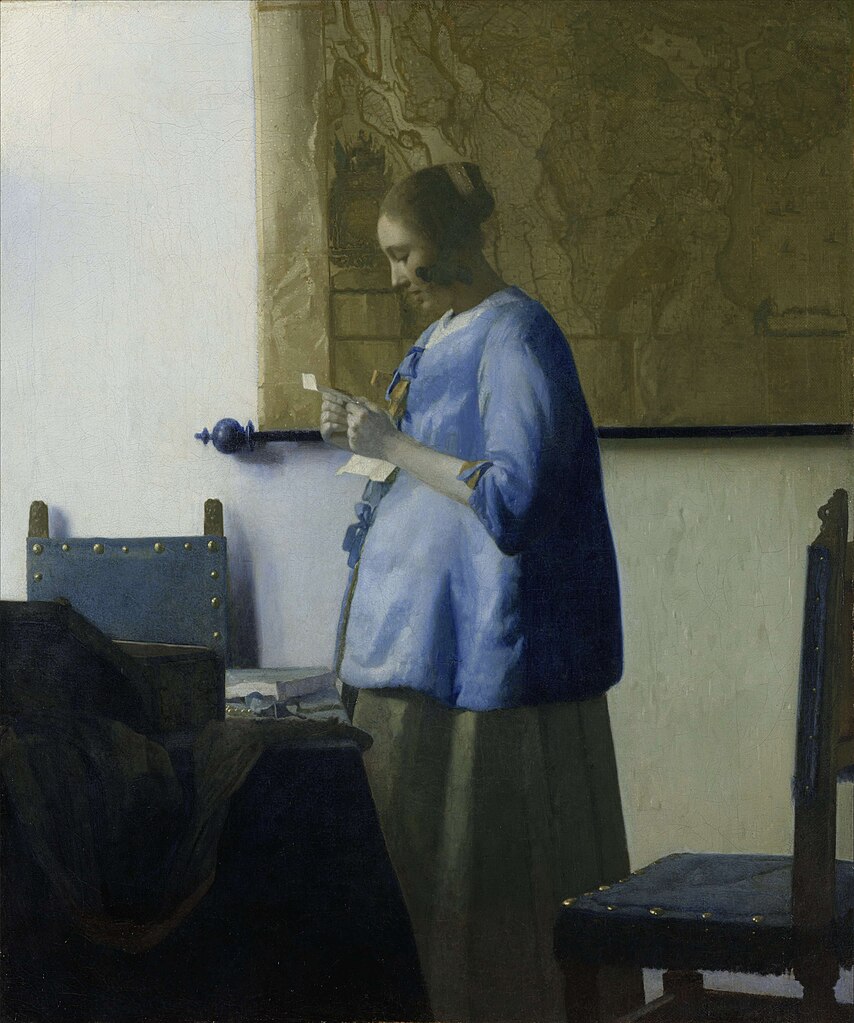
Vermeer's "Woman in Blue Reading a Letter" travels to Sao Paulo

The Rijksmuseum has started its global campaign for the Grand Opening on 13 April 2013 with an international tour of one of its masterpieces, Woman Reading a Letter. KLM Royal Dutch Airlines, the Rijksmuseum’s partner in transport, is flying this famous Johannes Vermeer painting to Shanghai, the Museu de Arte in São Paulo, Brazil, and the J. Paul Getty Museum in Los Angeles. At the Grand Opening Woman Reading a Letter will be on show again in the Rijksmuseum. After ten years of renovation, 13 April 2013 will see the Grand Opening of the Rijksmuseum, one of the world’s top museums. The world-famous collection will then be showcased in all its glory. Paintings by Rembrandt van Rijn, Johannes Vermeer, Frans Hals and Jan Steen will shine like never before in the new Rijksmuseum. The highlight is, of course, Rembrandt’s 1642 masterpiece the Night Watch, which will be on show again in its own Night Watch Gallery. Together, these paintings tell the story of the glorious Golden Age, when the Netherlands lead the way on the world stage and international trade brought great wealth and an unprecedented high level in the arts. Apart from the Golden Age, the new Rijksmuseum will also tell the story of 800 years of Dutch art and history using 8,000 objects made of porcelain and ceramics, silver and glass, as well as furniture, prints, drawings, photographs and costumes. Two beautiful period rooms will take visitors back to the riches and luxury of the Dutch 18th century. In the new Rijksmuseum, visitors will find the greatest Dutch art and the most exciting stories from 1200 AD to the present. Wim Pijbes, General Director of the Rijksmuseum: 'Vermeer’s Woman Reading a Letter is timeless and universal; she is our ideal ambassador.' The Rijksmuseum owns no fewer than four masterpieces from the very limited Johannes Vermeer oeuvre (34 pieces) that has survived. Vermeer specialised in everyday scenes and he was one of the masters of light. The woman in this painting is so lost in her letter that the silence is almost tangible. Woman Reading a Letter from c. 1663 is considered one of this artist’s most beautiful paintings.

http://www.artdaily.com/index.asp?int_sec=2&int_new=59493#.UMjtrmfNpT4[/url]

Tuesday, January 25, 2011

Germany's Prussian Cultural Heritage Foundation Refuses to Return Nefertiti Bust to Egypt

BERLIN (REUTERS).- A German foundation rejected Monday an Egyptian request to return the 3,400-year-old bust of Queen Nefertiti, a sculpture which draws over one million viewers annually to a Berlin museum.
Egypt's Supreme Council of Antiquities (SCA) sent the request to the Prussian Cultural Heritage Foundation, which runs the Neues Museum in the German capital where the bust is kept.
"The foundation's position on the return of Nefertiti remains unchanged," foundation president Professor Hermann Parzinger said in a statement. "She is and remains the ambassador of Egypt in Berlin."
Egypt's antiquities chief, Zahi Hawass, appealed to the foundation seeking the return of the bust, famed for its almond-shaped eyes and swan-like neck. However, the foundation said it did not consider the letter an official state request as it had not been signed by Egyptian Prime Minister Ahmed Nazif.
German archaeologist Ludwig Borchardt discovered the bust about 275 km south of Cairo in 1912, and it was taken to Germany the following year.
Hawass, who sent a similar letter in 2009, has said in the past that documents presented by the Neues Museum confirmed Borchardt tried to pass the bust off as a less significant find to secure it for Berlin. The museum has said it was acquired lawfully and Egypt had no legal claim to it.


The SCA, which Hawass heads, said in an email that its request had been approved by both Prime Minister Nazif and the Egyptian ministry of culture.
"This request is a natural consequence of Egypt's long-standing policy of seeking the restitution of all archaeological and historical artefacts that have been taken illicitly out of the country," it said.
Hawass has campaigned to repatriate several pharaonic treasures in recent years, including the Rosetta Stone now in the British Museum.

(Reporting by Eric Kelsey in Berlin and Patrick Werr in Cairo; writing by Brian Rohan; editing by David Stamp)
http://www.artdaily.com/index.asp?int_sec=2&int_new=44425

Tuesday, January 4, 2011

MORGAN HERRIN

     Construction grade 2x4s are the material of choice for Morgan Herrin's intricate hand-carved sculptures. It takes almost a year to complete a project such as this one, the study of a knight in 15th century armour morphing out of a series of stalactites and stalagmites. The contrasts in this large-scale wood sculpture bring the viewer to consider the passage of time and the effects of nature. The classical aspect of Herrin's work is heightened by the attention to detail. Here is what Morgan has written about his new work:

     "Untitled Knight is the product of the combination of two subjects: 15th century plate armor, and geological cave structure. Studied separately, these two subjects are completely unrelated. The man-made geometric precision of plate armor is formally opposite the flowing, organic nature of stalactites and stalagmites. Seen together, these two parts present a striking contrast in form and create a theme of time and the effects of nature. The pose of the figure and the general composition are references to the classical sculpture “The Dying Gaul” of ancient Roman antiquity. Rendered entirely in laminated construction-grade 2 x 4s, the material itself irreverently contradicts this classical allusion, and at the same time draws attention to our own culture’s reliance on the fast, cheap, and impermanent."
Morgan Herrin Biography     
        
1992-1993       Private Sculpture Lessons with Martin Delabono, Dallas TX            
1997                Life Drawing Lessons at Southern Methodist University, Dallas TX            
1997 - 1998    Private Life Drawing Lessons with Ellen Soderquist, Dallas TX            
1998 - 2002    BFA from Virginia Commonwealth University, Richmond VA            
2002 - 2005    MFA from The Ohio State University Sculpture program, Columbus OH    
       
Selected Exhibitions               
   
Mulherin Pollard Projects, 317 10th Ave, New York, NY
Lost World, ADA gallery, Richmond, VA            
Scope New York, ADA gallery            
Snap, Morlan Gallery, Lexington, KY            
Diamonds Cut Diamonds, Rare, New York, NY            
Columbus Biennale, Columbus OH            
Exchange Rate, Richmond VA            
FEAR, Polka Dot Gallery, Richmond,VA

Thanks to John Pollard,
owner & director of
ADA GALLLERY
and co-owner & director of MULHERIN POLLARD PROJECT

Wednesday, December 29, 2010

Ned Martin - Time Passages

Jan 5-27, reception Sat 8 Jan:

Time Passages. STUDIO VOGUE Gallery is pleased to welcome Ned Martin as one of several artists featured in Time Passages, our winter exhibition of gallery artists. Martin transports the viewer to a familiar place through a universal language and gives pause, even for a brief moment, to celebrate the unique quality of his subject. Martin will be joined by Jackie Hall, J. A. Fligel, Donna Koster, Victor Oriecuia, and Vivien Schmidt among others. This eclectic selection is sure to warm up a winter's day with works in oil and acrylic, bronze and marble sculpture, and fine art photography.

Ned Martin is a Realism Oil Painter who lives in New York, New York. He spent his early life and his years as an art major at Towson State University in Maryland exploring various painting media including acrylics, watercolor, pastels, and gouache. Several years ago, he began painting in oils and furthered his formal art training at The Schuler School of Fine Art in Baltimore where he learned the traditional oil painting techniques and principles of Jacques Maroger and the Old Masters.

Ned has embraced the Schuler School experience and continues to meticulously prepare his own wood panels and grind his own paint. While his paintings appear realistic, upon close scrutiny the viewer is delighted with broken impressionistic layers of paint that imply realism. Ned invests considerably in scrubbing, scratching, and scrapping layers of textured paint until a realistic form reveals itself.


STUDIO VOGUE Gallery – representing mid-career and emerging artists from Canada and around the world.
274 Avenue Road, Toronto ON M4V 2G7 (just N of Dupont)
Wed-Sat 12-6. Mon & Tues by appointment
T: 416 459 9809
info@studiovoguegallery.com
www.studiovoguegallery.com

Thursday, December 23, 2010

A Kingly Velázquez Is Discovered at the Met, Capping Off a Busy Year for the Old Masters

NEW YORK— Just in time for Christmas, scholars at the Metropolitan Museum of Art have given themselves a giant Velázquez, though in truth it is more of a re-gifting — the portrait of Philip IV of Spain had originally come into the collection nearly 100 years ago, but its attribution was downgraded in 1973 to the Old Master's studio. Now, a new cleaning effort has returned the work conclusively to the revered painter's column, according to the New York Times.
Despite possessing a 1624 receipt for the painting that was signed by Velázquez, the Met had reconsidered the portrait's authorship in the 1970s as part of a general auditing of its European painting collection that humbled attributions on 15 percent of its holdings, with the Philip canvas raising doubts in part because of over-varnishing inflicted by its previous owner, legendary dealer Lord Duveen. But a year-long restoration process of the work — which has not weathered the years well, losing an eye at one point, possibly to a vandal — has persuaded connoisseurs that the doubts had been misplaced. "One of the greatest painters of Western tradition — and a royal portrait to boot — is vindicated," Met European paintings chairman Keith Christiansen told the Times. Velázquez scholar Jonathan Brown has likewise welcomed the news. "Although it has suffered losses, what remains is by Velázquez," he said.
The reattribution comes improbably hard on the heels of another Velázquez discovery in the Met's collection, a circa 1630 "Portrait of a Man" that was determined to be by the artist's hand, and not his studio, in September of 2009. But the New York institution is not alone in finding treasures under its nose, and the Old Masters have been popping up everywhere this year. A third Velázquez was discovered by a specialist at the Yale University Art Gallery this summer — making for a remarkable spate of discoveries given that the painter is known to have made only about 110 works during his lifetime.
Then an enormous peasant scene by Pieter Bruegel the Elder was recognized by the Prado in Madrid, a Rembrandt was noticed hanging in the waiting room of the Rotterdam's Boijmans van Beuningen Museum, a giant once-waterlogged crucifix painting was attributed to Giotto in Florence, a potential Michelangelo pietà painting was spotted in an upstate New York home, and the Vatican even said it had uncovered a previously unknown Caravaggio just in time for the 400th anniversary of his death... but had to take back the claim when it was widely debunked

By ARTINFO Published: December 21, 2010
Image is courtesy The Metropolitan Museum of Art

Wednesday, July 21, 2010

The Spectacular Art of Jean-Léon Gérôme

By STAN PARCHIN
The J. Paul Getty Museum is the first of three venues to present The Spectacular Art of Jean-Léon Gérôme (June 15-September 12, 2010). This much-anticipated special exhibition, the first of its kind in nearly 40 years, features 99 works by the French artist (1824-1904) and important contemporaries. In light of recent scholarship, the show reconsiders the life and oeuvre of the academic painter and sculptor whose brilliant career was eclipsed by the development of Impressionism, Post-Impressionism and the Modernist avant-garde. In Los Angeles, California, the installation is organized thematically and chronologically by Mary Morton, Curator and Head of the Department of French Paintings at the National Gallery of Art and Scott Allen, the Getty's Assistant Curator of Paintings.
Jean-Léon Gérôme (French, 1824-1904). The Snake Charmer (ca. 1870). Oil on canvas. 83.4 x 122.1 cm. Sterling and Francine Clark Art Institute.

Gérôme and Painting
During the early 1840s, Jean-Léon Gérôme excelled at the atelier (studio) of noted Parisian painter Paul Delaroche (1797-1856). He continued his education with his mentor in Italy. After his return to France, Gérôme attended the prestigious École des Beaux-Arts. He competed unsuccessfully for the Prix de Rome in 1846, having been disqualified in the final round because of inadequate figure-drawing skills. This disappointment profoundly influenced the artist's perpetual preoccupation with painting the perfect nude.
Jean-Baptiste Carpeaux (French, 1827-1875). Portrait of Jean-Léon Gérôme (1872-73). Marble. H. 61 cm. J. Paul Getty Museum.

Despite the setback, the indefatigable Gérôme's The Cockfight (1847), a genre scene of adolescent sexuality set in a classical landscape, was well-received at that year's Salon. The recognition bolstered the artist's ambitions as a history painter throughout most of the next decade. He was foiled once again when the critics' disliked his monumental allegorical The Age of Augustus (1855), an official commission for French Emperor Napoleon III (r. 1851-70).

The disillusioned Gérôme then turned his attentions to small-scale historical and Orientalist compositions. The Death of Caesar (1867) was acknowledged for the artist's meticulous rendering of the immense Roman Senate's archaeological details as well as its portrayal of the dramatic events that unfolded following the ruler's cold and calculated assassination. The inventive imagery of Gérôme's subsequent The Snake Charmer (ca. 1870) was due, in part, to his 1853 trip to Constantinople (modern-day Istanbul, Turkey). There he derived inspiration from everyday life in the East to paint exotic scenes with the realistic clarity of photography, a new medium he greatly admired.
Jean-Léon Gérôme (French, 1824-1904). The Death of Caesar (1867). Oil on canvas. 85.5 x 145.5 cm. Walters Art Museum.

The Lure of Sculpture
Always interested in antique art, Gérôme devoted much of his later career to sculpture, frequently cross-referencing his paintings and statues. The artist premiered his first bronze sculpture, a gladiator trampling upon his victim, at the Universal Exposition of 1878.

The current exhibition displays 10 of Gérôme's works in bronze, marble, ivory and mixed media. It also fittingly includes the painter's famous oil on canvas Pygmalion and Galatea (1890), in which he retells the ancient Roman myth about a sculptor who fell in love with his own creation brought to life by a goddess.

Jean-Léon Gérôme (1824-1904). Pygmalion and Galatea (ca. 1890). Oil on canvas. 88.9 x 68.6 cm. The Metropolitan Museum of Art/Art Resource, NY.

After the J. Paul Getty Museum, "The Spectacular Art of Jean-Léon Gérôme" travels to the Musée d'Orsay, Paris (October 18, 2010-January 23, 2011) and the Thyssen-Bornemisza Museum, Madrid (March 22- June 12, 2011).


Source
Morton, Mary and Scott Allen (eds.), et al. Rediscovering Gérôme. Los Angeles: J. Paul Getty Museum, 2010. 

http://artmuseumjournal.com/jean_leon_gerome.aspx